Climate, Power Pricing and Site Selection for Mining
At 10 PH/s, electricity is the largest line item a mining operation has: about 200 kW of draw at 20 J/TH works out to 4,800 kWh a day, roughly $288 at $0.06 per kWh, against about $380 a day of gross mining income at the read-date network hashrate of 1,003 EH/s. Site selection is therefore mostly a power-contract decision with a cooling problem attached — and the cooling problem is priced in joules per terahash, not in adjectives about weather.

Key takeaways
- One cent per kWh is worth about $48 a day at 10 PH/s, which is more than three times the listed 4% pool fee on the block-reward component at the same scale.
- A cooling penalty of 1 J/TH at 10 PH/s is 10 kW, or 240 kWh a day — about $14.40 at $0.06 per kWh, every day, in every difficulty environment.
- Site B at $0.085 per kWh pays about $408 a day for the same 4,800 kWh, against roughly $380 of gross income: the machines are sound and the contract is not.
- Every 1% of hashrate lost to downtime or stale shares costs about $3.80 a day at 10 PH/s, so uptime and network latency deserve a line in the same comparison as the tariff.
Definitions first
Three quantities decide a site's economics, and they are often mixed together. Joules per terahash is hardware efficiency: how many watts a machine draws to produce one terahash per second, and it barely changes from country to country. Ambient temperature and humidity set how far that efficiency can be pushed before a machine throttles, and they change a great deal. The electricity tariff is contractual, and it is the only one of the three that can be renegotiated without buying new hardware.
Pool economics sit underneath all three. A pool settles your shares under a published rule, with the listed fee applied to the components it settles: 4% on the PPS-settled block reward and 2% on the PPLNS-distributed components. That is a real cost, but it is a percentage of income — it does not appear in a power bill and it does not scale with cooling.[1]
The trade-off nobody prices
Cooling is usually treated as a fixed overhead rather than a variable to be compared between sites. The arithmetic disagrees. At 10 PH/s, a machine fleet that runs 1 J/TH hotter than its best case burns an extra 10 kW, which is 240 kWh a day and about $14.40 at $0.06 per kWh. Over a month that is roughly $432 — comparable to the entire listed pool fee on the block-reward component, which is about $15.20 a day at this income level.
| Lever | Physical effect at 10 PH/s | Cost per day |
|---|---|---|
| Electricity tariff, +1 cent per kWh | 4,800 kWh a day becomes $48 more expensive | About $48 |
| Cooling penalty, +1 J/TH | 10 kW extra draw, 240 kWh a day | About $14.40 at $0.06 per kWh |
| Downtime or stale shares, 1% | 1% of 0.00449 BTC a day is not mined | About $3.80 of income |
| Listed PPS+ fee on the block reward | 4% of the block-reward component | About $15.20 |
| Thermal throttling, 5% of hashrate | 500 TH/s idle during hot hours | About $19.00 of income |
The table is why climate belongs in a site-selection spreadsheet but should not lead it. A hot region with a firm $0.035 per kWh contract will beat a cool region at $0.075 per kWh on almost any configuration, because the tariff gap is worth far more than the cooling gap it creates. Climate decides how expensive the same contract is to operate; the contract decides whether the site works at all.
Example with two setups
Take the same 10 PH/s fleet of 20 J/TH machines to two sites. Site A signs at $0.06 per kWh with reliable ambient conditions and grid capacity the operator can actually draw. Daily power is 4,800 kWh, or $288. Gross mining income at the read-date difficulty, hashrate and BTC price of $84,692 is about $379.93, and the listed 4% fee on the block-reward component leaves roughly $364.73. Against Site A's $288 power bill, the operating margin is around $76 a day before anything else.
Site B signs at $0.085 per kWh for the same capacity. The machines consume the same 4,800 kWh, but the bill is $408 a day — against $379.93 of gross income. No pool setting, firmware profile or payment method recovers that gap, because the cost sits above the income line before fees are even applied.
Now add climate. Suppose Site B is 12°C cooler on average and the operator can therefore run the same hardware 1 J/TH more efficiently for most of the year. That is 10 kW, 240 kWh a day, $14.40 — the cooling advantage is real but it is a rounding error against the $120 a day tariff gap. This is the pattern to expect whenever someone argues that a cold location justifies a higher power price. It usually does not, and the arithmetic above is how to check in five minutes.
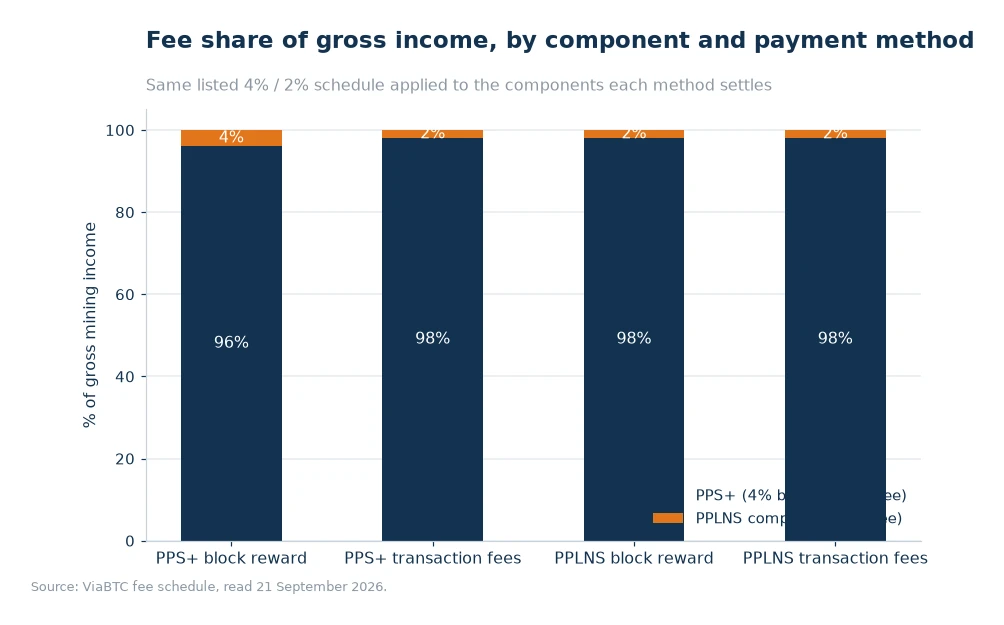
Keep the fee chart in proportion. A pool charging a listed 4% on the PPS-settled block reward and 2% on the PPLNS-distributed components is charging on income you have already earned; a tariff is charged on energy you have already consumed. The second is the bigger number at every scale worth operating at, and it is the one a site decision can still change.
Two tools belong in the same spreadsheet. A miner profitability ranking shows which machine models still clear their electricity cost at today's price and difficulty, which is the natural starting point for choosing what to install at Site A or Site B. A pool dashboard covers the other side of the equation: the hashrate and difficulty behind the $379.93 daily figure, updated as the network moves.
Practical next steps
- Price the tariff in dollars per day, not cents. Multiply kWh by the rate and compare it against gross income at the read-date difficulty, not against a hoped-for price.
- Measure the cooling penalty on site. Compare power draw at the hottest hour of the year against the machine's best J/TH figure; the difference is a permanent cost, not a seasonal one.
- Treat uptime as revenue. A site with a 5% outage pattern gives up about 5% of income — roughly $19 a day at this scale — which is usually more than any fee negotiation can recover.
- Check network latency before signing. Global node coverage keeps stale shares low; a distant endpoint can cost a percent of effective hashrate that never appears in a marketing table.
- Choose the payment method for the cash-flow shape you need. Hourly settlement smooths income; per-block distribution with a lower listed fee suits operations that can absorb variance. Hosted capacity with an integrated mining account keeps that choice independent of the site decision.
- Re-run the numbers at every difficulty change. The estimate on the read date was −2.12%, worth roughly 2.2% more per share if it lands — enough to change the ranking of two marginal sites.
For operators who would rather not own the site at all, hosted capacity through ViaBTC Mining Farms covers power, cooling and housing in one arrangement, which turns the comparison above into a question about a contract instead of a construction project.
Frequently asked questions
Is a bigger pool always better?
Size reduces payout variance but also concentrates hashrate. What matters more is fee structure, uptime, latency and payout cadence.
What happens if my miner goes offline?
Shares stop, so expected income stops with them. Alerts and a dashboard that shows per-worker hashrate shorten the gap between a failure and a fix.
How much does the power tariff matter for a mining site?
It is usually the largest operating cost. At 10 PH/s with 20 J/TH hardware, one cent per kWh is worth about $48 a day, against about $15.20 a day for the listed 4% fee on the block-reward component.
Does a cold climate guarantee cheaper mining?
No. Cooler ambient conditions reduce cooling overhead, but the same fleet at 1 J/TH better efficiency saves only about $14.40 a day at 10 PH/s, far less than a two-cent tariff difference.
The short version
Rank sites by tariff first, cooling second, uptime third, and pool terms fourth. One cent per kWh at 10 PH/s is worth roughly $48 a day; 1 J/TH of cooling overhead is worth about $14.40; 1% of lost hashrate is worth about $3.80. Those three numbers, applied to a real contract, will decide a site's outcome long before any discussion about climate or pool fees does.
Data and sources: ViaBTC fee schedule and hosted-capacity documentation[1] and the ViaBTC pool statistics view[2]. Network hashrate, difficulty, subsidy and BTC price read from public chain data on 21 September 2026. Power figures are illustrative and depend on the contract and hardware in use.