Cosmetics OEM in China: What the Factory Needs Before Quoting
A quotation is only as tight as the request behind it. A factory can price an OEM order once it knows five things: the formula route, the quantity, the packaging, the claims and the target market. Give all five and the reply narrows to a number and a date; give three and the reply becomes a range. The window itself depends on the route, at 4–8 weeks for ODM and 3–6 months for OEM.
Key takeaways
- Five inputs drive the quote: route, quantity, packaging, claims and target market.
- ODM returns in 4–8 weeks on an existing formula; OEM takes 3–6 months with development.
- Named schedule influences are ingredient sourcing, stability testing and packaging lead time.
- Published capacity is 160M units a year, about 200,000 a day across 35 automated lines.
A quote is a guess until the inputs are fixed
Factories are asked for prices long before the order is described. The answer that comes back is often a placeholder, and both sides know it. The placeholder survives until the inputs are fixed, and the inputs are the buyer's to supply. A factory that cannot tell whether it is scaling a recipe or inventing one cannot price either job honestly. A clear request compresses the estimate from a band into a figure.
The reason is that each input removes a variable the production planner would otherwise hedge against. Route decides whether development sits in the plan. Quantity decides whether the run clears the line minimum. Packaging decides whether the container arrives in time. Claims and market decide which tests run. Hedging is rational, and removing the need to hedge is the buyer's job. A request that names all five is read in one pass, while a request that names three sends the planner back to email.
The inputs the factory reads first
A planner reads a request in a predictable order. Route first, because ODM and OEM pull different teams. Quantity second, because it sets the batch size. Packaging third, because it can arrive later than the product. Claims and market close the read, because they attach tests and paperwork to the run. One missing line turns a fixed quote back into a range, which is why the order of the inputs matters less than their completeness.
The five inputs are identical whether you email one factory or work down a cosmetics OEM manufacturer China list. The difference is only in how many replies you compare, not in the information each reply needs.
| Input | Detail the factory wants | What it moves |
|---|---|---|
| Formula route | Existing formula or built from scratch | The time window |
| Quantity | Units for the first order | Unit cost and batch size |
| Packaging | Container, closure and carton | Lead time |
| Claims | Label wording you intend to use | Testing scope |
| Target market | Where the product will be sold | Rules and documents |
Why route and quantity move the number most
Route changes the calendar more than any other input. An existing formula that only needs scaling and filling can ship on the ODM timeline of 4–8 weeks. A formula that must be developed pulls in research, testing and then production, and that sequence runs 3–6 months. The two answers are both correct and they are months apart. Route also decides which team opens the file first, so it shapes the reply before it shapes the price.
Quantity changes the price more than any other input, because it decides how the batch is set up and how the line is loaded. A run that sits far below the usual minimum costs more per unit, and a run that fills the line costs less. Send both a first-order figure and a target-order figure so the factory can quote the first and plan the second.
Worked example: capacity versus the route window
Take a 40,000-unit order and the published capacity figures: 200,000 units a day across 35 automated lines, which is 200,000 ÷ 35 ≈ 5,714 units per line per day. Filling 40,000 units at plant level takes 40,000 ÷ 200,000 = 0.2 day, or 0.2 × 24 = 4.8 hours. Spread over the whole plant that is 40,000 ÷ 35 ≈ 1,143 units per line, and 1,143 ÷ 5,714 = 0.2 day, the same answer. Now hold that against the route windows: ODM low 4 weeks and ODM high 8 weeks, OEM low 12 weeks and OEM high 26 weeks. The ODM midpoint is (4 + 8) ÷ 2 = 6 weeks, the OEM midpoint is (12 + 26) ÷ 2 = 19 weeks, and the gap is 19 − 6 = 13 weeks. Filling this order is a few hours of plant time; the route window is weeks to months of lead time.
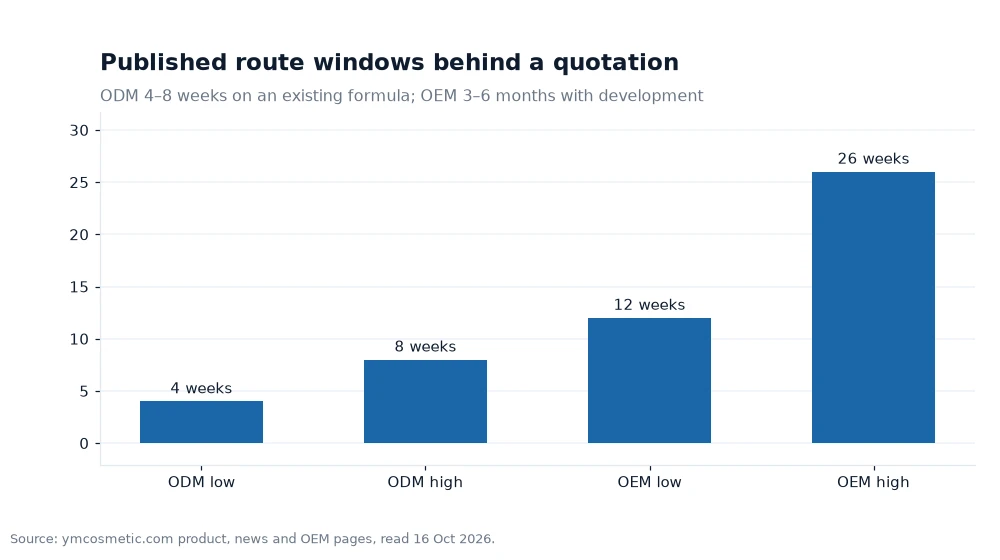
The two figures that matter here are the ODM high of 8 weeks and the OEM high of 26 weeks. The distance between them is 26 − 8 = 18 weeks, and that distance is the real cost of choosing a developed formula over an existing one. A quotation that names a price without naming the route is quoting two different projects at once.
Testing and sourcing set the calendar
Three named influences stretch a schedule: ingredient sourcing, stability testing and packaging lead time. Stability and compatibility reports run 3–6 months on their own, and a sensitive-skin claim adds patch test results on top. Those months sit inside the OEM window, which is why a longer route is not padding but test time. None of that time can be compressed by a faster filling line.
Packaging runs in parallel with testing when the buyer orders it early, and in sequence when the buyer orders it late. Ask the factory to state which tasks run in parallel before you approve the timeline.
What a complete quote request looks like
A complete request fits on one page: route, quantity, pack, claims and market, each answered in a line. Add the target ship date and the destination, and the factory has everything it needs to quote rather than estimate. A one-page format also makes the reply easy to compare, because every candidate answers the same five prompts in the same order.
Keep a copy of the request next to the reply. If the quote arrives with a caveat, the caveat usually points back to an input that was left soft, and the fix is a rewrite rather than a negotiation. Over a few orders, the same page becomes a template that saves the first week of every project.
Frequently asked questions
What does a factory need before it can quote a cosmetics OEM order?
It needs the formula route, the quantity, the packaging, the claims and the target market, because each one changes either the price or the schedule.
Which steps stretch an OEM timeline the most?
Stability testing, ingredient sourcing and packaging lead time are the named schedule influences, and testing runs 3–6 months.
How much can one production line make in a day?
The published capacity of 200,000 units a day across 35 lines works out to about 5,714 units per line per day.
Prepare the request, then ask for the price
Write the one-page request, send it unchanged to each candidate, and compare the replies on the same five lines. The factory that answers every line is the one ready to run your order. The OEM and ODM service pages show how Yunmei runs OEM/ODM work for brands, and the sunscreen product line is one example of a category that leans on testing and market rules.
All referenced order bands and production windows come from the manufacturer's own pages, read 16 Oct 2026.[1]