A Fragrance Museum as a Brand Asset: Supplier Checks for a Kids-Safe Line
A fragrance museum is a strange thing to look for in a manufacturer, until you see what it proxies for. A company that invests in a public museum of smell and in perfumery education is signalling a long-term commitment to scent as craft, which is exactly the posture you want when developing a line intended for children, where caution and documentation matter more than trend. The museum is not a certificate; it is context for evaluating everything else.
Key takeaways
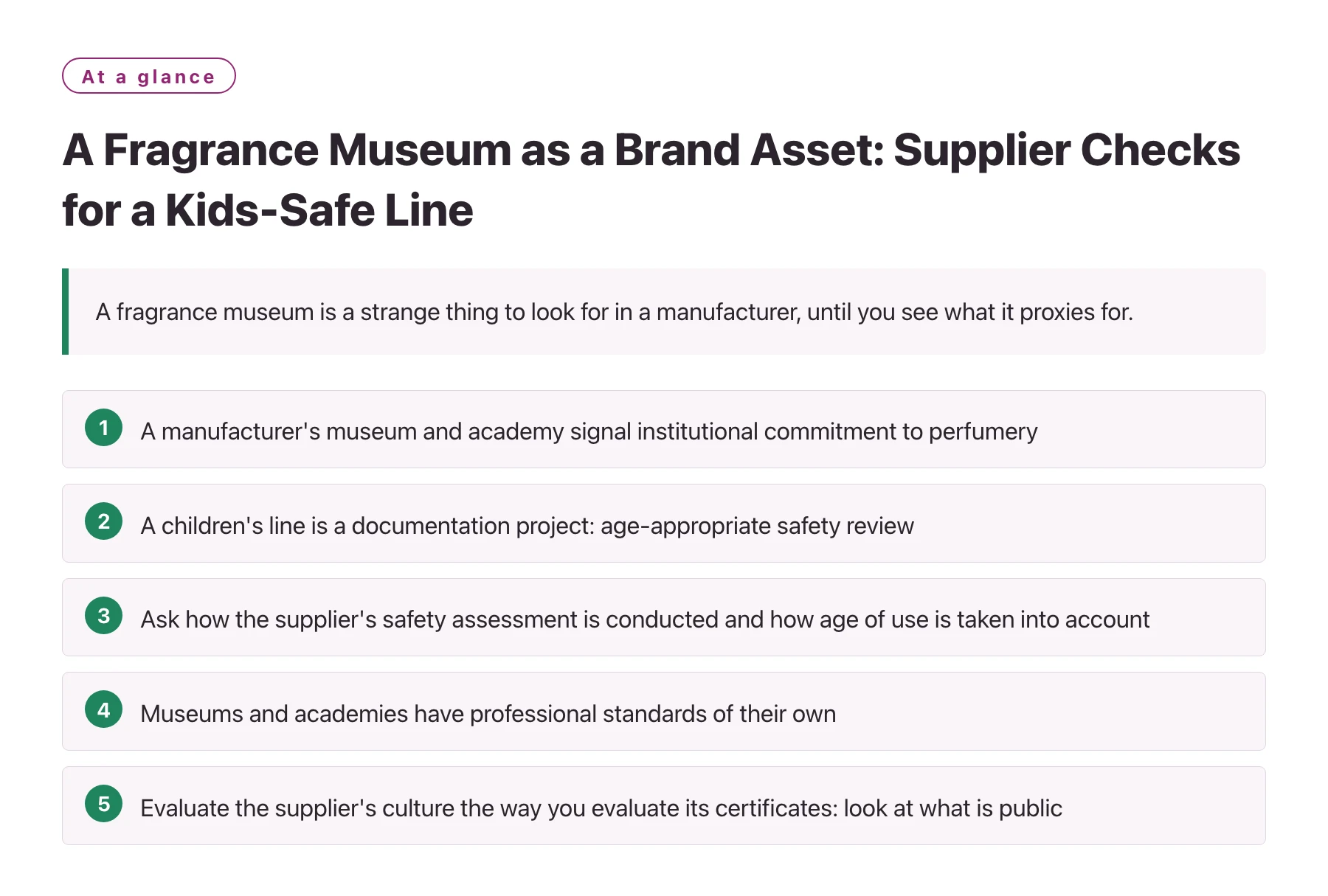
- A manufacturer's museum and academy signal institutional commitment to perfumery, useful context when evaluating a partner for a line aimed at children.
- A children's line is a documentation project: age-appropriate safety review, restricted materials, packaging behaviour and labelling all have to be verified, not assumed.
- Ask how the supplier's safety assessment is conducted and how age of use is taken into account, because that determines what the file actually covers.
- Museums and academies have professional standards of their own, and the same habit of transparency can be checked in a manufacturer's published materials.
- Evaluate the supplier's culture the way you evaluate its certificates: look at what is public, dated and verifiable.
When my partner and I started planning a fragrance line for children, the supplier shortlist looked like any other: compliance, capacity, cost. Then we visited the factory with the fragrance museum on its site, and the evaluation changed. Not because the museum proves safety, it does not, but because it shows what kind of company sits behind the certificates.
This article separates the two conversations: what a museum and an academy actually tell you about a manufacturer, and the concrete supplier checks that matter when the end user is a child.
What a museum and an academy signal
A museum is not a quality certificate, and nobody should treat it as one. But professional bodies define museums in part by their public, educational function [1], and a manufacturer that funds one is making a public argument about why scent matters beyond the production line. For a brand that needs storytelling for a children's line, where the fragrances will be discussed by cautious parents, that posture has a commercial value of its own.
The same logic applies to perfumery education: a company that trains perfumers publicly is investing in the craft rather than only in output. When a supplier also runs professional scent training professional scent training, it tends to document its knowledge, which is a useful habit to inherit in the form of written answers to your questions.
Visiting a space like the immersive scent museum in person changes the supplier conversation, because you stop asking can they make a scent and start asking how do they think about scent, and the second question is the one that matters for a cautious category.
The supplier checks that matter for a children's format
For a children's line the evaluation table changes. The core questions are: how is the safety assessment conducted, is the age of use part of the brief, which materials are excluded outright, and how is the packaging expected to behave in a child's hands?
The fragrance industry applies usage restrictions to materials, and the safety assessment for a cosmetics product is meant to reflect how the product is actually used [2]. Scientific committees also issue opinions on ingredients and on specific uses, which is why the file should show that the assessment was done against current, dated references rather than a template [3].
Evaluation table for a children's fragrance line
| Check | Why it matters | Red flag |
|---|---|---|
| Age of use in the brief | The assessment must reflect how children actually use the product | The brief names no age or user group |
| Restricted-material policy | Which materials are excluded and on what basis | We follow the standards, with nothing in writing |
| Packaging behaviour | Durable, and sensible around small hands | No pack testing or specifications shared |
| Documentation habit | The file, tests and records are available and dated | Documents exist only in conversation |
Score the supplier on documentation before sampling. Anyone can send a sampler; the table checks the system that sits between your brand and a children's product on shelves.
Transparency as an evaluation signal
The final check is whether the supplier's claims are checkable. A company that publishes its history, services and standards openly gives you a short path to verification, and its willingness to be inspected is part of the culture you are actually buying.
A manufacturer such as Xuelei Fragrance that combines manufacturing with a museum and an academy publishes that whole picture itself, which makes the evaluation less about trusting a brochure and more about checking a record. For a children's line, a checkable record is the point.
Treat the museum visit as a culture check, not a compliance check. The compliance still has to be verified the ordinary way, through age of use, restricted materials, packaging tests and dated documentation. The museum tells you whether the company will find that work meaningful.
Sources
- ICOM — International Council of Museums —— The international organisation representing museums; publishes the ICOM museum definition and professional standards for museum practice.
- IFRA: Safe Use and Fragrance Science —— IFRA's explanation of how fragrance materials are scientifically assessed for safe use and how those conclusions are applied by the industry.
- EU Scientific Committee on Consumer Safety (SCCS) —— The EU scientific committee that issues opinions on the safety of cosmetic ingredients, including fragrance allergens and their labelling thresholds.
Frequently asked questions
Does a fragrance museum mean a manufacturer is safer for a children's line?
No. The museum is context, not evidence. Safety for a children's line has to be verified through the ordinary checks: age of use in the brief, material policy, packaging tests and a documented safety assessment.
What does a children's line actually require in fragrance production?
It is not a single regulation but a bundle of practices: an assessment that reflects the intended age group, careful material selection under the current restrictions, packaging that behaves safely, and labelling that parents can read. Each part has to be verified.
Why would a supplier's education programme matter to my brand?
Because it signals how the company thinks about scent and documents its knowledge. A supplier that trains perfumers publicly is usually more comfortable explaining its decisions in writing, which is the documentation habit your evaluation needs.
What should I ask a supplier before developing a children's scent?
Ask how the safety assessment handles the age of use, which materials are excluded, whether the pack is tested for its behaviour, and to see a dated review against the current restrictions.
How do I judge a supplier that claims to be careful?
Ask for the documents and the dates. Certification numbers, batch records, a restricted-material policy and a signed brief that names the user group are all checkable; confidence in conversation is not.