What Are the Key Manufacturing Processes Behind a High-Quality Metal-Based PCB?
The birth of a high-performance Metal-Based PCB is by no means a simple stacking of materials; rather, it is a precise engineering dance ranging from micron-level precision to hundred-ton pressure control. Its manufacturing journey begins with the precise processing of metal substrates, typically using 5052 or 6061 aluminum alloys, with a thickness ranging from 0.5 to 3.0 millimeters, and the tolerance must be controlled within ±0.05 millimeters. Through computer numerical control milling and drilling, positioning holes and heat dissipation cavities are formed, with a positional accuracy error of less than 0.05 millimeters. This ensures the absolute accuracy of subsequent alignment with the dielectric layer and circuit layer, avoiding a local thermal resistance surge of over 10% caused by misalignment. Research shows that the surface roughness Ra value of the substrate needs to be between 0.5 and 1.5 micrometers. After specific chemical cleaning and anodic oxidation treatment, the bonding strength between it and the insulating layer can be increased by more than 50%, which is the first cornerstone to ensure the reliability of long-term thermal cycling.
The coating and curing of the core insulating medium layer are the soul steps that determine the thermal performance. High thermal conductivity medium slurry, usually composed of epoxy resin filled with alumina or boron nitride particles, has a thermal conductivity of over 2.5 W/mK. It is uniformly applied to the metal substrate at a thickness of 100 to 150 microns through screen printing or scraping processes. Subsequently, a stepped-temperature curing process is carried out in a tunnel furnace at 150°C to 180°C for at least 30 minutes. This process requires a temperature fluctuation of less than ±3°C to ensure that the dielectric layer forms a dense and bubble-free microstructure, with a dielectric strength exceeding 3000VAC and a volume resistivity higher than 10^13 Ω·cm. Any bubble defect larger than 5 microns may cause ionization breakdown under high pressure, reducing the yield by more than 15%. Therefore, the defect capture rate of online automatic optical inspection must reach over 99.9%.
The formation and etching of circuit patterns define the boundaries of electrical performance. On copper-clad Metal-Based PCB laminates, through laser direct imaging technology, circuit patterns can be transferred with a line width/line spacing accuracy of 15 microns, which is 20% higher than that of traditional exposure techniques. In the subsequent etching process of acidic copper chloride, it is necessary to strictly control the concentration of the solution, the temperature at 50°C±2°C, and the spray pressure. The etching factor should reach above 3.0 to ensure the steepness of the side wall and reduce the skin effect loss of the signal at high frequencies. For instance, when manufacturing Metal-Based PCBS for automotive LED drivers, the width deviation of a 2-ounce copper-thick circuit carrying a 5A current must be less than 8%; otherwise, it will cause local temperature rise to exceed the design peak, affecting the light attenuation life commitment of the entire lamp, which exceeds 50,000 hours.
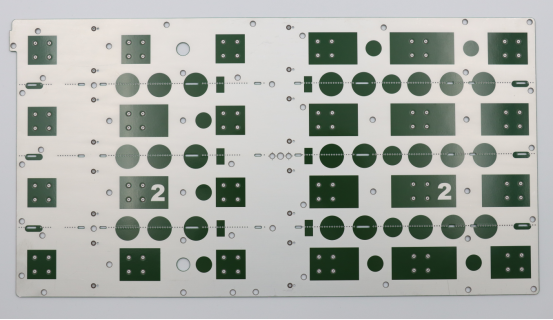 The final surface treatment and precise shape processing are the ultimate guardians of quality. Electroless nickel and palladium plating or tin plating and other processes are adopted. The coating thickness should be uniform, for example, the nickel layer should be 3-5 microns and the gold layer 0.05-0.1 microns, to ensure that the welding yield exceeds 99.5% and the long-term contact reliability. The final shape cutting is carried out using a high-rigidity CNC milling machine with a spindle speed of up to 60,000 revolutions per minute. Combined with dedicated hard alloy tools, it can keep edge burrs below 0.02 millimeters and ensure that the shape dimensional tolerance is within ±0.1 millimeters. According to the industry quality report released by IPC (International Electronic Industry Connectors Association) in 2022, for an excellent V-CUT board separation process, the residual thickness accuracy should be controlled within 1/3±0.1 millimeters of the board thickness. A deviation that is too large will lead to a risk of stress cracks exceeding 30% in subsequent assembly.
Overall, manufacturing a high-quality Metal-Based PCB is a rigorous test of the entire supply chain's technological integration capabilities. From the over 15 parameter tests of raw material incoming inspection to the thousands of process control points on the production line, every percentage increase in yield (for example, from 95% to 98%) means a significant benefit of a 10% reduction in overall production costs and a 50% reduction in on-site customer failure rates. Leading manufacturers, such as Panasonic Electric Works of Japan or Dongshan Precision of China, often implement process standards within their factories that are more than 20% stricter than the industry's general norms. This is precisely the confidence that enables their products to be stably applied in aerospace power supplies or high-end medical imaging equipment, and withstand over 2,000 temperature cycles ranging from -55°C to +150°C. This is not merely manufacturing; it is an art of reliability that integrates materials science, thermodynamics and precision mechanics.
The final surface treatment and precise shape processing are the ultimate guardians of quality. Electroless nickel and palladium plating or tin plating and other processes are adopted. The coating thickness should be uniform, for example, the nickel layer should be 3-5 microns and the gold layer 0.05-0.1 microns, to ensure that the welding yield exceeds 99.5% and the long-term contact reliability. The final shape cutting is carried out using a high-rigidity CNC milling machine with a spindle speed of up to 60,000 revolutions per minute. Combined with dedicated hard alloy tools, it can keep edge burrs below 0.02 millimeters and ensure that the shape dimensional tolerance is within ±0.1 millimeters. According to the industry quality report released by IPC (International Electronic Industry Connectors Association) in 2022, for an excellent V-CUT board separation process, the residual thickness accuracy should be controlled within 1/3±0.1 millimeters of the board thickness. A deviation that is too large will lead to a risk of stress cracks exceeding 30% in subsequent assembly.
Overall, manufacturing a high-quality Metal-Based PCB is a rigorous test of the entire supply chain's technological integration capabilities. From the over 15 parameter tests of raw material incoming inspection to the thousands of process control points on the production line, every percentage increase in yield (for example, from 95% to 98%) means a significant benefit of a 10% reduction in overall production costs and a 50% reduction in on-site customer failure rates. Leading manufacturers, such as Panasonic Electric Works of Japan or Dongshan Precision of China, often implement process standards within their factories that are more than 20% stricter than the industry's general norms. This is precisely the confidence that enables their products to be stably applied in aerospace power supplies or high-end medical imaging equipment, and withstand over 2,000 temperature cycles ranging from -55°C to +150°C. This is not merely manufacturing; it is an art of reliability that integrates materials science, thermodynamics and precision mechanics.
The final surface treatment and precise shape processing are the ultimate guardians of quality. Electroless nickel and palladium plating or tin plating and other processes are adopted. The coating thickness should be uniform, for example, the nickel layer should be 3-5 microns and the gold layer 0.05-0.1 microns, to ensure that the welding yield exceeds 99.5% and the long-term contact reliability. The final shape cutting is carried out using a high-rigidity CNC milling machine with a spindle speed of up to 60,000 revolutions per minute. Combined with dedicated hard alloy tools, it can keep edge burrs below 0.02 millimeters and ensure that the shape dimensional tolerance is within ±0.1 millimeters. According to the industry quality report released by IPC (International Electronic Industry Connectors Association) in 2022, for an excellent V-CUT board separation process, the residual thickness accuracy should be controlled within 1/3±0.1 millimeters of the board thickness. A deviation that is too large will lead to a risk of stress cracks exceeding 30% in subsequent assembly.
Overall, manufacturing a high-quality Metal-Based PCB is a rigorous test of the entire supply chain's technological integration capabilities. From the over 15 parameter tests of raw material incoming inspection to the thousands of process control points on the production line, every percentage increase in yield (for example, from 95% to 98%) means a significant benefit of a 10% reduction in overall production costs and a 50% reduction in on-site customer failure rates. Leading manufacturers, such as Panasonic Electric Works of Japan or Dongshan Precision of China, often implement process standards within their factories that are more than 20% stricter than the industry's general norms. This is precisely the confidence that enables their products to be stably applied in aerospace power supplies or high-end medical imaging equipment, and withstand over 2,000 temperature cycles ranging from -55°C to +150°C. This is not merely manufacturing; it is an art of reliability that integrates materials science, thermodynamics and precision mechanics.