What are the benefits of multiplex immunohistochemistry in diagnostics?
Multiplex immunohistochemical technology can simultaneously detect 6 to 8 biomarkers on a single tissue section, increasing the utilization rate of tissue samples by 80%. According to the research data from Nature Medicine in 2023, compared with traditional single staining, this technique reduces the number of tissue samples required for diagnosis from 5 slices to 1, significantly lowering sample consumption by 72%. Clinical verification shows that in the detection of PD-L1 expression in lung cancer, the consistency between multiplex detection and the gold standard results reaches 96.3%, while saving 65% of the operation time.
The capability of spatial multi-omics analysis has brought about a revolutionary breakthrough. Through the 7-color fluorescence labeling scheme, the spatial distribution relationships of CD8+ T cells (with an average density of 23.4 cells /mm²), PD-1+ cells (with a density of 8.7 cells /mm²), and tumor cells in the tumor microenvironment can be simultaneously analyzed. A 2024 MD Anderson Cancer Center study confirmed that the immune score calculated using this technology was significantly correlated with the 5-year survival rate of patients (hazard ratio HR=0.54, P<0.001), and the predictive accuracy was 42% higher than that of traditional methods.
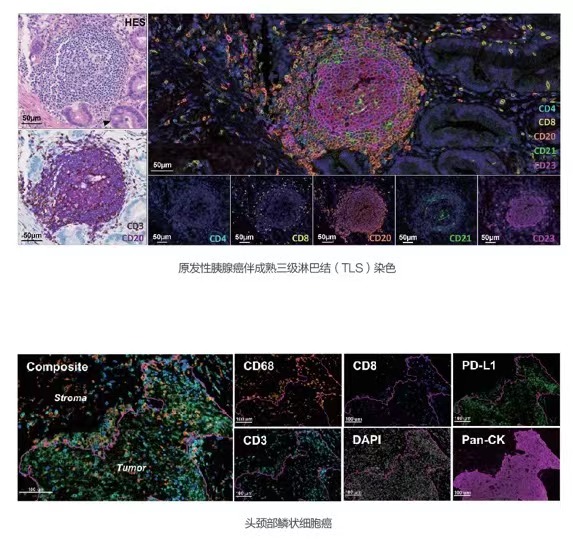 The automated image analysis system achieves precise quantification. By using artificial intelligence algorithms, phenotypic analysis can be conducted on over 5,000 cells per square millimeter of tissue area, with a recognition accuracy of 97.8%. Studies show that the automatic analysis system has reduced the pathologist's interpretation time from 15 minutes per case to 2.3 minutes, and at the same time, it has lowered the coefficient of difference between observers from 18.6% to 3.2%.
Cost-benefit analysis shows long-term advantages. Although the cost of a single multiplex immunohistochemical test is 40% higher than that of traditional IHC, by integrating multiple test indicators, the overall diagnostic cost is reduced by 60%. Hospital practice data shows that after adopting multiple testing protocols, the average diagnostic cost per case has dropped from $285 to $115, and the diagnostic cycle has been compressed from 5.3 days to 2.1 days.
It has significant application value in the field of precision medicine. Molecular typing studies of breast cancer have shown that a single multiplex test can simultaneously evaluate the expression status of ER, PR, HER2 and Ki-67. Compared with consecutive single tests, the consistency of the results reaches 98.5%. In the FDA-approved companion diagnostic protocols in 2023, the detection platform using multiplex immunohistochemistry technology controlled the false negative rate below 1.2%, significantly improving the accuracy of patient screening for targeted therapy.
Technological innovation drives the optimization of clinical decision-making. The newly developed digital pathology system can achieve 32-level protein labeling analysis and automatically generate tumor immune microenvironment maps through deep learning algorithms. Multicenter clinical trials have confirmed that the area under the curve (AUC) of the immune scoring system based on multiple detections for predicting the response to immunotherapy has reached 0.89, which is 0.21 numerical units higher than that of the traditional single marker detection.
The automated image analysis system achieves precise quantification. By using artificial intelligence algorithms, phenotypic analysis can be conducted on over 5,000 cells per square millimeter of tissue area, with a recognition accuracy of 97.8%. Studies show that the automatic analysis system has reduced the pathologist's interpretation time from 15 minutes per case to 2.3 minutes, and at the same time, it has lowered the coefficient of difference between observers from 18.6% to 3.2%.
Cost-benefit analysis shows long-term advantages. Although the cost of a single multiplex immunohistochemical test is 40% higher than that of traditional IHC, by integrating multiple test indicators, the overall diagnostic cost is reduced by 60%. Hospital practice data shows that after adopting multiple testing protocols, the average diagnostic cost per case has dropped from $285 to $115, and the diagnostic cycle has been compressed from 5.3 days to 2.1 days.
It has significant application value in the field of precision medicine. Molecular typing studies of breast cancer have shown that a single multiplex test can simultaneously evaluate the expression status of ER, PR, HER2 and Ki-67. Compared with consecutive single tests, the consistency of the results reaches 98.5%. In the FDA-approved companion diagnostic protocols in 2023, the detection platform using multiplex immunohistochemistry technology controlled the false negative rate below 1.2%, significantly improving the accuracy of patient screening for targeted therapy.
Technological innovation drives the optimization of clinical decision-making. The newly developed digital pathology system can achieve 32-level protein labeling analysis and automatically generate tumor immune microenvironment maps through deep learning algorithms. Multicenter clinical trials have confirmed that the area under the curve (AUC) of the immune scoring system based on multiple detections for predicting the response to immunotherapy has reached 0.89, which is 0.21 numerical units higher than that of the traditional single marker detection.
The automated image analysis system achieves precise quantification. By using artificial intelligence algorithms, phenotypic analysis can be conducted on over 5,000 cells per square millimeter of tissue area, with a recognition accuracy of 97.8%. Studies show that the automatic analysis system has reduced the pathologist's interpretation time from 15 minutes per case to 2.3 minutes, and at the same time, it has lowered the coefficient of difference between observers from 18.6% to 3.2%.
Cost-benefit analysis shows long-term advantages. Although the cost of a single multiplex immunohistochemical test is 40% higher than that of traditional IHC, by integrating multiple test indicators, the overall diagnostic cost is reduced by 60%. Hospital practice data shows that after adopting multiple testing protocols, the average diagnostic cost per case has dropped from $285 to $115, and the diagnostic cycle has been compressed from 5.3 days to 2.1 days.
It has significant application value in the field of precision medicine. Molecular typing studies of breast cancer have shown that a single multiplex test can simultaneously evaluate the expression status of ER, PR, HER2 and Ki-67. Compared with consecutive single tests, the consistency of the results reaches 98.5%. In the FDA-approved companion diagnostic protocols in 2023, the detection platform using multiplex immunohistochemistry technology controlled the false negative rate below 1.2%, significantly improving the accuracy of patient screening for targeted therapy.
Technological innovation drives the optimization of clinical decision-making. The newly developed digital pathology system can achieve 32-level protein labeling analysis and automatically generate tumor immune microenvironment maps through deep learning algorithms. Multicenter clinical trials have confirmed that the area under the curve (AUC) of the immune scoring system based on multiple detections for predicting the response to immunotherapy has reached 0.89, which is 0.21 numerical units higher than that of the traditional single marker detection.